Some roads don’t look like places where lives get saved.
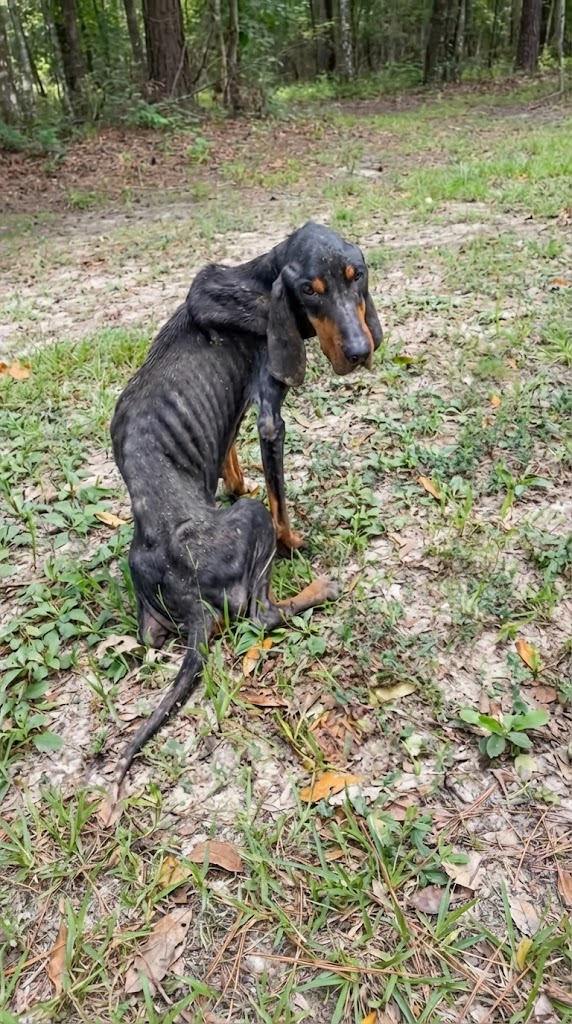
The road where Nora was found was almost empty — a quiet stretch outside town where the dust settles quickly and the world keeps moving without looking down.
That’s why the first person who noticed her didn’t understand right away what they were seeing.
At first, she looked like a shadow dragging itself along the shoulder of the road — too slow to be healthy, too deliberate to be windblown debris.
Then she lifted her head.
And the truth became impossible to ignore.
Nora was alive…
But barely.
Her body was painfully thin, as if hunger had hollowed her from the inside. Her legs trembled under her weight. Each step looked like a decision made with the last of her strength.
She wasn’t exploring.
She wasn’t wandering.
She was doing the only thing her instincts still knew how to do:
Keep moving.
Keep trying.
Survive one more hour.
No one knows how long she had been out there. But the signs weren’t the signs of a single bad day.
They were the signs of a slow collapse.
Dehydration.
Prolonged malnutrition.
Severe diarrhea that had likely drained her until her body could no longer hold warmth or strength.
Her eyes weren’t aggressive.
They weren’t guarded.
They were just… exhausted — in a way that felt older than her body should have carried.
When rescuers approached, they moved carefully. Dogs this depleted can react unpredictably.
But Nora didn’t bark.
She didn’t snap.
She didn’t even try to run.
She simply looked at them — quietly — as if deciding whether hope was safe.
And then… she let them come closer.
A blanket was wrapped around her thin frame.
Gentle hands lifted her up.
She felt lighter than she should have — like she’d been disappearing for days.
During the ride to safety, she stayed still, breathing shallowly, conserving what little was left.
It wasn’t a dramatic rescue.
No chaos. No noise.
Just quiet urgency.
Because everyone understood the same thing:
Nora was on the edge.
And there was no time to waste.
VIDEO: Step by Step Back to Life — Nora’s Quiet Comeback from the Edge
When Even Food Could Be Dangerous
At the clinic, the situation became clear fast.
Nora’s dehydration was so severe that her body couldn’t safely handle large amounts of food or water. When a body has been deprived for too long, even nourishment can become dangerous if it comes too quickly.
So the team did what experienced rescuers do.
They slowed everything down.
Fluids first — carefully measured, delivered in a way her system could tolerate.
Then nutrition — drop by drop, syringe-fed in tiny portions, spaced out throughout the day.
It wasn’t about feeding her a meal.
It was about teaching her body how to receive again.
In the beginning, Nora barely reacted.
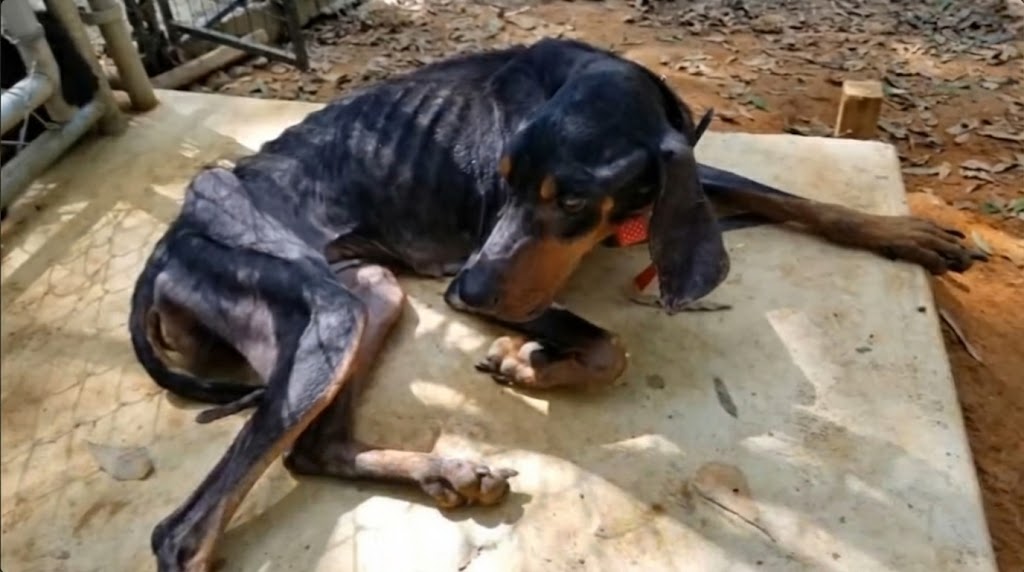
She lay still on soft bedding, her head turned away from the bowl.
It wasn’t refusal.
It was exhaustion.
When your body is fighting just to stay awake, eating can feel impossible.
So her caregivers stayed close.
Watching her breathing.
Checking her gums.
Monitoring her temperature.
They weren’t just treating a dog.
They were holding a fragile life in place long enough for recovery to take root.
And the hardest part was the uncertainty.
Because rescue work carries a truth that’s never spoken loudly — sometimes the body has already crossed too far into shutdown.
Even when love is perfect.
Even when care is immediate.
That fear sat quietly in the room.
Until something shifted.
The Smallest Movement That Changed Everything
It wasn’t big.
It wasn’t cinematic.
But it was real.
Nora lifted her head.
Just a small movement — but it said:
I’m still here.
A little later, she accepted a few sips of water.
Her eyes focused briefly, tracking a caregiver’s face.
And the entire atmosphere changed — not with loud celebration, but with gentle relief.
Hope returned.
Not dramatic.
Not loud.
Just steady.
Healing Came in Pieces People Could Easily Miss
Over the next days, progress arrived in small fragments:
A slightly stronger breath.
A longer stretch of sleep.
A few bites swallowed without discomfort.
Her meals were soft and carefully prepared, mixed with supplements her body desperately needed.
Sometimes she wore a little coat — because her weakened system couldn’t regulate temperature well.
Warmth mattered as much as food.
Comfort mattered as much as medicine.
And slowly, Nora began to respond to routine.
That’s when something deeper started to heal.
Because recovery isn’t only physical.
For a dog who has been unseen for too long, safety is something the nervous system has to relearn.
Trust doesn’t appear because a bowl is placed down once.
Trust grows when the bowl is there tomorrow, too.
When the voice stays gentle every time.
When hands do not hurt.
When rest becomes uninterrupted.
The Bath That Felt Like a Turning Point
One of the quiet turning points came during her first bath.
Nora was dirty from the road. Her coat was dull, her skin needed care.
Warm water flowed over her, and everyone expected survival-mode tension.
But Nora didn’t panic.
She didn’t fight.
She leaned into the touch — softly.
Not begging.
Not demanding affection.
Just accepting it.
As if something inside her remembered what care felt like… even if she hadn’t had it in a long time.
It was a small moment.
But it mattered.
Because it wasn’t just cleanliness.
It was connection.
When Curiosity Came Back, So Did Nora
After that, her curiosity returned in gentle waves.
Once she could stand more steadily, she began to explore — slow steps around the shelter, cautious sniffing, frequent pauses to rest.
She watched other dogs from a distance.
Then a little closer.
She noticed toys — not with playfulness at first, but with interest.
And then, almost unexpectedly…
She began to engage.
Puppies in the shelter sparked something in her.
Their innocent energy pulled her out of survival mode and into something softer.
At first, she simply observed.
Then she walked near them.
Then she allowed them to sniff her.
In rescue work, those moments are everything.
Because they mean the heart is opening again.
From “Barely There” to Fully Here
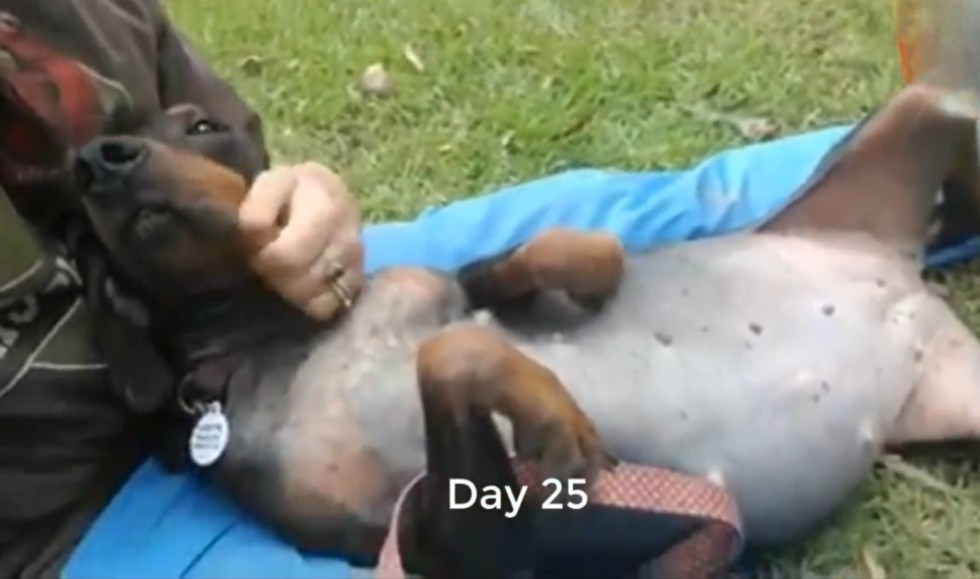
As weeks passed, Nora’s physical changes became easier to see.
Weight returned gradually.
Her coat began to look healthier.
Her movements became more stable.
But the most powerful transformation was in her posture.
She stopped carrying herself like a dog waiting for something bad to happen.
Her shoulders relaxed.
Her eyes softened.
She began to greet people instead of bracing for them.
By around day ten, she was brighter.
By day twenty, she was stronger.
By day thirty, she was moving with confidence.
And by day forty…
It was hard to believe she was the same dog found trembling on an overlooked road.
A Life That Finally Feels Safe
Today, Nora runs and plays and rests without fear.
She eats without urgency.
She sleeps deeply.
She greets each day with the calm joy that only comes when survival is no longer the job.
Nora’s story isn’t just about being saved.
It’s about being rebuilt — slowly, patiently, piece by piece.
Because recovery isn’t instant.
And it isn’t loud.
Sometimes it looks like a dog lifting her head for the first time.
Sometimes it looks like a tiny tail wag.
Sometimes it looks like trust forming quietly in a warm bath.
And sometimes, it looks like this:
A dog who once had nothing left…
Moving forward anyway —
Step by step —
Into a life that finally feels safe.