The Necklace At The Center Table
The restaurant glowed like wealth trying to look innocent.
Warm light spilled from hand-blown chandeliers.
Crystal glasses caught gold reflections.
Expensive wine breathed in tall decanters.
Soft piano drifted through the room with the kind of restraint that made every laugh sound curated, every gesture rehearsed, every marriage at every table appear more stable than it probably was.
At the center table sat Vivienne D’Arcy.
She knew how to occupy a room the way some women wear perfume—not merely to be noticed, but to decide the temperature around them. Her dress was black silk cut with the confidence of old money. Her lipstick was perfect. Her diamonds were chosen not for sparkle but for message. She looked like she owned the light falling across her shoulders.
Her husband sat beside her.
Julian Vale.
One hand around his glass.
One careful smile.
The kind of man people describe as “measured” when what they really mean is “dangerous in a quiet way.”
They were entertaining clients. laughing softly. looking every bit the untouchable couple a room full of strangers could envy from a safe distance.
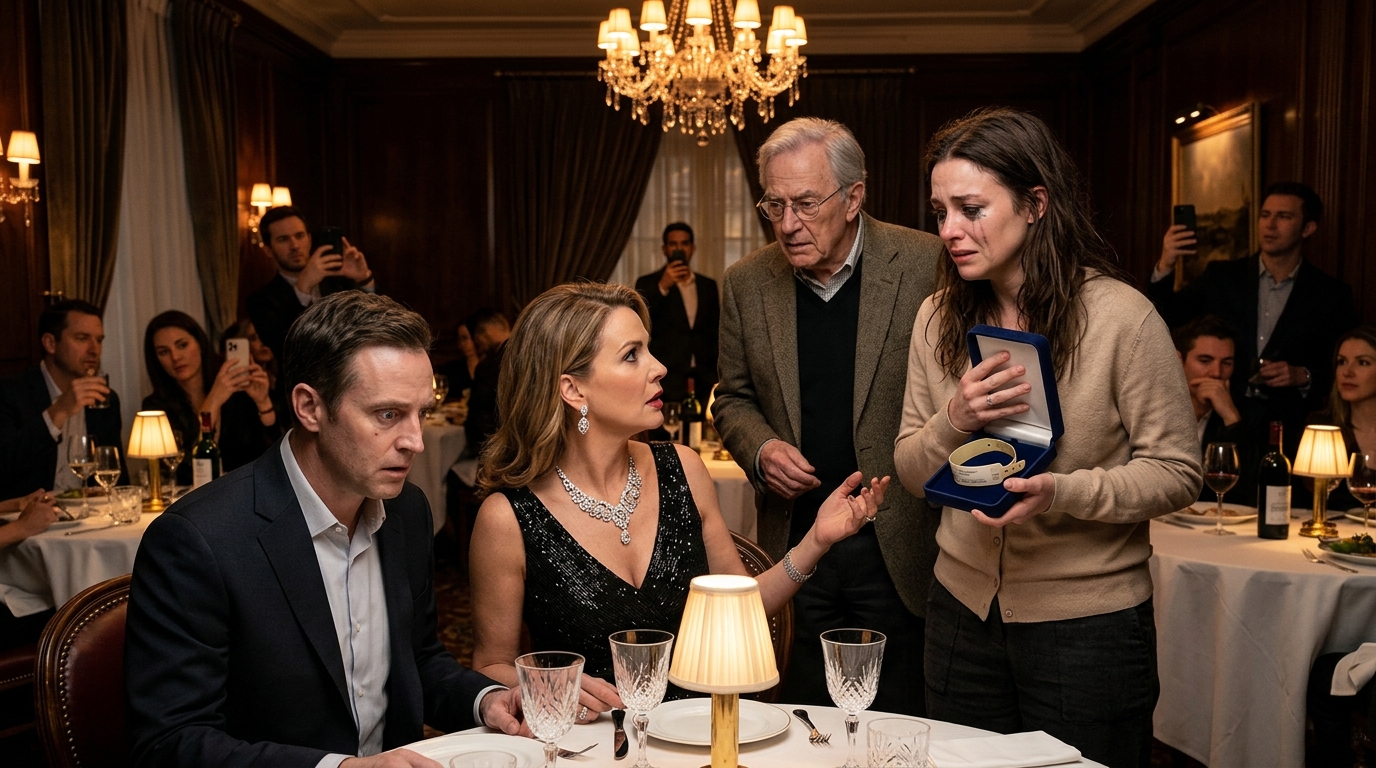
Then the crying woman appeared.
I saw her before anyone else did.
She stood just beyond the candlelight near the aisle between tables, badly dressed for a place like that and aware of it in every line of her body. Her coat was cheap and slightly too large. Her shoes were damp at the toes. Her mascara had already run in dark rivers beneath her eyes as though she had been crying long before she entered the restaurant and simply no longer had anything left with which to stop.
And in both hands, pressed so tightly to her chest that her knuckles had gone white, was a small velvet necklace box.
For one suspended second, nobody noticed her except me.
Then Vivienne turned.
The change in the room was immediate.
Not dramatic at first.
Just a shift.
A tightening.
The subtle, predatory awareness wealthy rooms develop the instant something arrives that does not belong to them.
Vivienne stood so fast her chair scraped the floor.
“You came back again to steal my husband in front of everyone?!”
The sentence cracked through the restaurant like glass breaking under heat.
The piano stopped.
Heads turned.
Phones rose almost instantly from three different tables.
The crying woman flinched but didn’t run.
That was what stayed with me.
She looked terrified enough to fold in half, but she stayed.
Mascara streaked her face.
Her lips trembled.
Her whole body shook with the effort of remaining upright under fifty strangers’ eyes.
Vivienne stepped toward her, every inch of the scene now under her control.
“Tell them how much money you want this time!”
A few guests exchanged looks.
Someone at the next table started recording more openly.
A waiter froze with a bottle of Burgundy halfway above a glass.
The woman shook her head so hard it looked painful.
“I don’t want money,” she cried.
Then she looked at Julian.
Directly.
“I want to know why you’re wearing my mother’s necklace.”
Silence didn’t merely fall.
It crashed.
Every face in the room turned from her to the necklace around Vivienne’s throat.
A crescent collar of old diamonds, narrow and elegant, centered by a pale blue sapphire shaped like a tear.
Julian froze.
Not offended.
Not outraged.
Frozen.
Vivienne’s expression flickered for the first time.
And then, from the far corner of the dining room, an elderly man slowly rose.
Henri Marchal.
Master jeweler.
Founder of Marchal et Fils.
The last man in Bordeaux who still recognized certain custom clasps by touch alone.
He stepped closer, eyes fixed on the necklace.
The whole room watched as he leaned in—not at Vivienne’s face, not at the diamonds, but at the clasp hidden beneath the fall of her hair.
The moment he saw it, all color drained from his face.
His fingers began to shake.
“That piece,” he whispered, voice low and horrified, “was custom-made for the woman they said died before the marriage certificate was signed.”
Gasps spread through the restaurant in waves.
The crying woman lifted her tear-soaked face and looked straight at Julian.
“Then tell them,” she said through tears, “why she wrote your surname on my birth papers.”
Julian looked like he could no longer find enough air.
Vivienne turned toward him slowly.
And before anyone in the room could speak, the crying woman opened the velvet box, revealing an old hospital bracelet inside, and whispered:
“Or should I show them what she hid with the necklace before they buried her?”
The Wife They Buried Before The Law Could Catch Up
My name is Celine Armand.
I did not go to that restaurant to make a scene.
I went because grief rots differently when it has paperwork inside it.
For twenty-three years, I had carried three things my mother left behind:
a velvet box,
a hospital bracelet,
and a surname that did not belong anywhere unless one particular man told the truth.
That man was Julian Vale.
The same Julian now standing beneath chandeliers in a navy suit while his elegant wife wore a necklace that should have been buried with a woman called dead before the law finished marrying her.
My mother’s name was Elise Moreau.
At least, that was the name she used with me.
To the city records, when they mentioned her at all, she was a woman who died in a car accident twelve days before her civil marriage to Julian Vale could be finalized. Tragic. unfortunate. conveniently timed. Her death had always been treated like a nearly-wedding, not a marriage. A sorrow without legal residue.
Except my mother never spoke of it that way.
When she was ill and the medication loosened her memory from her caution, she used different words.
He was already calling me his wife.
He said the certificate was only timing.
He said names matter more than signatures when a man means them.
And then, always after that, she would go quiet.
Too quiet.
The kind of quiet that teaches children there are certain doors in a story you are not supposed to push on unless you are prepared for what opens.
I did not know the full shape of it when I was young.
Only fragments.
A hidden necklace she never wore but never threw away.
A hospital bracelet wrapped in velvet.
A photograph with one corner burned off.
A drawer she locked even when there was nothing in the room worth stealing.
And on the back of my birth papers, under my given name, one surname written in her hand and then crossed through so violently the paper nearly tore:
Vale.
She told me never to show anyone unless Julian appeared in front of me wearing another woman’s certainty.
At fifteen, I thought that meant heartbreak.
At twenty-three, I knew it meant danger.
Then my mother died.
Not dramatically.
Not in a cinematic room full of last words.
In a narrow hospice room smelling of antiseptic and rain, with one hand gripping mine and the other groping weakly for the velvet box on the bedside table.
“If you ever see the necklace again,” she whispered, “it means he’s decided I’m dead enough to reuse me.”
I didn’t understand at first.
Then she opened the box.
Inside was the hospital bracelet.
Paper-thin plastic gone brittle with age. Her name. The maternity ward number. And beside it, folded twice, a note in her handwriting:
If he gives the necklace to another wife, show her the bracelet first. Then ask him why he wanted my daughter born under his name before the law could ask what he had promised.
That note lived against my skin for eight years.
I never used it.
Until the society pages published a photograph from a charity gala three weeks earlier—Vivienne D’Arcy in black silk, smiling beside Julian Vale, wearing my mother’s necklace.
That was when I understood my mother’s final warning.
He wasn’t simply moving on.
He was repurposing the dead.
And men only do that when they believe the last witness has already learned to stay silent.
So I went to the restaurant.
Not for money.
Not for blackmail.
Not for revenge.
For recognition.
Because once a room full of wealthy strangers sees a lie crack in public, the lie can never fully return to private life again.
The Bracelet Inside The Velvet Box
Henri Marchal took the bracelet from my hand with the kind of care people use for relics and explosives.
His eyes moved over the faded lettering.
Then up to Julian.
Then back down again.
“Maternity Ward Saint-Catherine,” he whispered. “July 14.”
He looked at me.
“And your mother was Elise Moreau?”
I nodded.
His face seemed to age five years in one breath.
“I made the necklace for her in June,” he said quietly. “At his request. He wanted the sapphire reset from his grandmother’s ring. Said it was for ‘the woman already carrying my future.’”
The room let out one long, collective inhale.
Julian did not move.
Vivienne stared at him, then at the bracelet, then at the necklace around her own throat as though it had suddenly become a hand clamped there.
I opened the bracelet fully so they could all see.
Mother: Elise M.
Infant female.
Provisional family name: Vale.
Provisional.
That single bureaucratic word carried more violence than a scream.
Julian found his voice first, because men like him always eventually do.
“This proves nothing,” he said.
The sentence landed badly.
Too fast.
Too dry.
Too practiced.
I laughed once, the sound breaking halfway because I was still crying too hard for it to become anything graceful.
“It proves enough,” I said. “Enough that you stopped breathing when I said her name.”
Vivienne stepped backward.
A chair caught against her calf.
She barely noticed.
Julian turned toward her at once, instinctively, the way liars turn not toward truth but toward the person whose belief still matters most to them.
“Vivienne—”
“No,” she said.
Just that.
No.
The room became still again.
Henri Marchal, who until that night had simply been an old jeweler eating fish in peace, now stood at the center of a collapsed marriage holding a hospital bracelet from a life that should never have reached his table.
He looked at Julian with open revulsion.
“That clasp,” he said, touching the necklace lightly, “was only used on pieces commissioned to remain inside one family line. You told me she would wear it at the signing dinner.”
Julian’s jaw tightened.
“She never did,” Henri continued. “Because three days before that dinner, they said she died.”
There it was.
The timeline.
The shape of the lie sharpening into something harder than rumor.
I reached inside my coat pocket and pulled out the rest of the folded documents I had sworn not to show unless the room turned against me before it turned against him.
My birth papers.
A photograph of my mother wearing the necklace while heavily pregnant.
And a letter sealed but never sent.
Julian’s face changed when he saw the letter.
Not fear.
Recognition.
That was worse.
Because it meant he already knew what it contained.
I held it up.
“She wrote this after the accident that was supposed to kill her.”
The room rippled.
Vivienne’s voice was barely audible now.
“Accident?”
I looked at her.
Not unkindly.
That surprised me even then.
Because in that moment she was no longer the glamorous wife humiliating me at center table.
She was simply the next woman standing too close to a man’s edited history.
“My mother lived,” I said. “That was the problem.”
The Woman Who Wasn’t Supposed To Survive
The private room upstairs still smelled the way old money likes to smell when it thinks no one outside can judge it.
Wax.
Wood polish.
Bordeaux breathed too long.
A trace of truffle from dinners better remembered by the people who paid for them than the people who served them.
We moved there because the dining room below had become unmanageable. Guests pressed too close. Phones multiplied. Someone from local press had already been called by somebody pretending they were “just worried.” Luc Morel—the owner—locked the main entrance himself, then guided us upstairs with the face of a man who had just realized his most loyal customer might also be the worst story his restaurant would ever host.
Vivienne came.
So did Julian.
So did Henri Marchal and Luc.
I insisted on that.
I wasn’t going to let Julian rearrange tone and context in some quiet office with no witnesses and then emerge looking wounded.
The letter on the table between us had gone soft at the edges from years of being unfolded and refolded.
I stared at Julian before I opened it.
“Tell her,” I said.
Vivienne looked at him sharply.
“Tell me what?”
Julian rested both hands on the back of a chair and said nothing.
I opened the letter.
The paper crackled.
My mother’s handwriting was narrower here than in the older notes, more jagged, like someone writing while drugged or frightened or both.
If anything happens to me again, do not believe what Julian says about my health.
He told Saint-Catherine I must be listed under his name because the family would make trouble before the certificate.
He told me the accident was chance.
But when I woke, they had moved the baby’s file and taken the necklace.
If I am unstable, why do all my fears keep happening exactly as I describe them?
Vivienne let out a breath that sounded like pain forced through clenched teeth.
I kept reading.
He says the law cannot protect a woman who has not finished becoming his wife.
He says I should rest and stop asking why my daughter’s surname was written before mine was.
If this reaches anyone, know this: I did not agree to disappear. I agreed to survive long enough to get her away.
Silence.
Not a restaurant’s silence now.
A room where everyone has just realized they are sitting inside a crime’s skeleton.
Henri lifted one hand to his mouth.
Luc turned to Julian.
“Saint-Catherine reported her dead.”
Julian’s eyes flicked toward the sealed windows.
Not at me.
Not at Vivienne.
Toward exits.
There was history in that reflex.
That was when I understood something else my mother had left unsaid because perhaps she thought I would notice it for myself when the time came.
Julian never lied like a man inventing.
He lied like a man selecting.
A smaller truth from a larger one.
A cleaner angle.
A version people could continue wearing in public.
Vivienne was staring at the letter now as if it might physically stain her.
“You told me she was a model you dated briefly,” she whispered.
Julian finally looked at her.
“He did not even give you the right category of betrayal,” I said.
She flinched.
He hated that.
I could see it.
Not because he cared for her pain, but because I had seized the room’s rhythm away from him.
He straightened.
“Elise was unstable after the birth. She refused treatment. She started inventing things.”
I slid the photograph across the table.
Elise in a hospital chair. Necklace at her throat. Bruise half-hidden beneath powder along the collar. Me in her arms, days old and unmistakably real. On the back, another note:
Taken after he said the legal papers would be ready by noon. By nightfall he had already changed the doctor.
Vivienne made a sound low in her throat and looked directly at Julian.
“You kept a woman medicated and moved after she had your child?”
He snapped then.
Not loudly.
Not wildly.
But the mask tore.
“I kept order,” he said.
There it was.
The true religion.
Not love.
Not grief.
Not duty.
Order.
Men like Julian always speak of order when they mean control that survived too long to remain ashamed of itself.
Henri’s hands shook harder now.
“My God,” he whispered, “you wore her stone on another woman’s throat while her daughter stood outside your life.”
Julian turned toward me.
“What do you want?”
Money, he meant.
Settlement.
Silence dressed better than before.
That was the final insult.
I leaned forward.
“I want the name of the clinic.”
And for the first time that night, Julian actually looked afraid.
The Surname On My Birth Papers
It took Vivienne, not me, to break him.
That still surprises me when I think about it.
Not because she was noble.
Not because she was kind.
But because humiliation does unusual things to rich women who realize they were chosen secondhand. Until that moment, Vivienne had still been deciding whether this could be negotiated into some elegant compromise. A mistress paid off. A madwoman’s daughter redirected. A story managed.
Then she unclasped the necklace from her throat.
Set it on the table between us.
And said, very quietly, “If I discover another woman had to disappear so you could marry me cleanly, I will personally burn your life to the foundations.”
Something in Julian’s face gave.
Perhaps he believed her.
Perhaps he knew women like Vivienne understand reputation the way surgeons understand flesh.
He sat down.
For the first time all night, he looked his age.
Older, almost.
He named the place without looking at me.
Maison de Repos Bellac.
A private recovery house outside Tours, owned through three shell companies and a charitable arts trust established in Elise’s memory after her “death.” That last part made Luc actually curse aloud.
Of course.
He had turned her disappearance into philanthropy.
That, more than anything, was Julian’s style. Never merely erase. Monetize the grief. Curate the sympathy. Build something tax-efficient on top of it so the lie feeds elegantly.
My hands were shaking again by then, but not from shame anymore.
From proximity.
From the sick and electric knowledge that after twenty-three years of inherited silence, I finally had a location.
“I want the transfer records,” I said.
Julian’s eyes lifted to mine at last.
“She won’t know you.”
The sentence hit with hideous precision.
Not because it frightened me.
Because it was meant to.
He was still trying to pre-write my experience. Soften the arrival. Reduce the woman to damage. Prepare me not to trust my own grief if the reunion went badly.
My mother had warned me in another note I found years after her death:
If he ever helps you find me, remember that even his truths arrive wearing poison.
Vivienne stood so abruptly her chair toppled.
“You are going to give her every record,” she said. “Tonight.”
He laughed once.
A dead sound.
“You think any of this leaves this room the way you want it to?”
Vivienne looked at him with a coolness so complete it almost made me pity him.
“Julian,” she said, “the moment she spoke downstairs, you ceased being a husband and became a liability.”
That landed.
Henri Marchal took the necklace gently from the table and turned the clasp toward the light again. “There is something else,” he murmured.
We looked over.
Inside the clasp, nearly invisible unless opened fully, was a second engraving beneath the maker’s mark.
E.M. / J.V. / For the child.
No date.
No ceremony.
No future bride.
For the child.
My eyes burned.
Because that meant one terrible and beautiful thing: whatever else Julian had done, however twisted the history, the necklace had originally been made not simply for Elise, but with me in mind. A first family object. A promise. Something intended to move from mother to daughter.
He saw me staring and understood at once what I had realized.
“Don’t romanticize it,” he said sharply. “It was jewelry.”
I looked at him.
“No,” I said. “For you, everything was.”
The Woman Beneath The New Name
We reached Bellac just before dawn.
A gray building behind iron gates.
Trimmed hedges.
Cream shutters.
The kind of private institution that photographs well for brochures and badly for truth.
Vivienne came too.
That shocked everyone, including me.
But by then I understood. She was no longer there as wife. She was there as witness. Perhaps avenger. Perhaps merely a rich woman who could not bear being made a fool in a room full of strangers.
Police met us at the gates with a magistrate and two tired administrators already attempting the first soft lies.
No such patient.
Records transferred.
Confidentiality laws.
Historical files unavailable without proper authorization.
Then Vivienne placed one call to a minister whose campaign Julian had once financed and the doors opened as if the building itself had been waiting for permission to stop lying.
They had not kept my mother under Elise Moreau.
They had kept her under Margot Vernes.
Room 18.
North wing.
Long-term nervous convalescence.
She was alive.
That sentence still does not feel like a sentence so much as a rupture.
Alive.
Not whole.
Not waiting by a window with perfect recognition in her eyes.
Not preserved like a tragedy for my convenience.
Alive in the difficult, unsentimental way real survivors are alive.
Thinner.
Older.
One side of her hair turned almost white at the temple.
Hands marked by years of medication tremors.
Eyes that had learned the shape of fluorescent ceilings too well.
She was sitting in a chair by the radiator when they opened the door.
For one awful second, she did not look at me.
She looked at the necklace in Henri’s hands.
Then at Vivienne.
Then finally at me.
Her mouth opened.
Closed.
Opened again.
And she whispered the first word no one else in the room could possibly have given her.
“Celine.”
Not because I introduced myself.
Because she knew me.
The way only a mother can know the face she last saw as a bundle and somehow carries forward through every nightmare anyway.
I went to my knees beside her.
Not elegantly.
Not consciously.
She touched my cheek with shaking fingers as if confirming I was not another sedation dream sent to test her.
“You kept your eyes,” she whispered.
I was crying too hard to answer.
Over her shoulder, one of the police officers asked the administrator where the transfer papers were stored. Someone mentioned criminal detention. Vivienne was already speaking to lawyers in a voice cold enough to frost glass. Henri stood by the window with the necklace in both hands, openly weeping without embarrassment.
My mother drew the hospital bracelet out of the velvet box and held it like a fragment of another planet.
“I hid it in the necklace case the day they moved me first,” she said. “I thought if I couldn’t keep the stone, I could at least keep one proof you were born before they buried me.”
I put my forehead against her hand.
She looked past me then.
At the doorway.
Julian stood there between two officers.
For once he had no room left to arrange.
My mother looked at him with no visible hatred at all.
Which was somehow more devastating.
“Did you at least tell yourself it was love?” she asked.
He said nothing.
Because what could possibly survive that question?
She smiled then.
A small, tired, merciless smile.
“That’s what I thought.”
The Necklace He Tried To Reuse
By noon, the story had left the restaurant and gone everywhere.
The necklace.
The letters.
The hospital bracelet.
The hidden surname on my birth papers.
The recovery house outside Tours.
The charitable foundation built in memory of a woman who had not been allowed to finish being dead.
Julian was arrested before sunset.
Not elegantly.
Not quietly.
Not the way men like him imagine consequence arrives.
Bellac’s director went with him.
Two doctors were suspended.
Three accountants disappeared from their offices and reappeared with counsel.
The foundation froze.
The trust auditors descended.
I should say I felt triumph.
I didn’t.
Not at first.
What I felt was the violent awkwardness of reunion. The practical difficulty of loving someone who survived years you cannot imagine without turning them into a saint or a ghost. My mother and I did not collapse beautifully into one another’s lives. We moved slowly. Carefully. Around pain, medication, memory gaps, legal interviews, and the strange, humiliating work of learning how to speak without the lie in the room between us.
But some truths help simply by existing.
She had not abandoned me.
I had not been unwanted.
The crossed-out surname on my birth papers had not been the fantasy of a sick woman.
And the necklace was never meant to become a trophy on another wife’s skin.
Three weeks later, my mother was strong enough to leave Bellac for a protected apartment in Bordeaux. On her first evening there, Henri Marchal brought the necklace back in a velvet tray.
He held it out to her.
“For the child,” he said.
My mother looked at me.
Then smiled in a way that made her resemble the younger woman in the photograph so suddenly it almost stole my breath.
“No,” she said softly. “For the daughter.”
She fastened it around my throat herself.
Her hands still shook.
But not from fear anymore.
When I looked in the mirror, the blue stone sat at the center of my collarbone like a cold piece of recovered history. Not just jewelry. Not romance. Not grief repurposed for display.
Proof.
Proof that a woman can be buried publicly and still return through the smallest surviving object.
Proof that a child can carry a surname erased on paper and still force it back into the room.
Proof that what men like Julian call order is often just theft waiting long enough to be mistaken for fact.
People still ask whether I regret going to that restaurant in tears, badly dressed, holding a velvet box like it was the last thing keeping me alive.
No.
Because it was.
And because the glamorous woman who humiliated me in public did not ruin my night.
She gave me the exact audience the truth had always needed.
By the time the room went silent, everyone understood what it had never been about.
Not money.
Not blackmail.
Not jealousy.
It was about a mother stolen before the marriage was legal.
A daughter who survived long enough to ask the right question.
And a necklace no lie in the world could wear forever.