The Shoe on the Marble
The first thing I remember is not my mother crying.
It is the shoe.
Black leather.
Sharp heel.
Too expensive to belong in the hand of a woman whose fingers had once buttoned my school shirts, buried my father, and steadied herself through forty years inside that house.
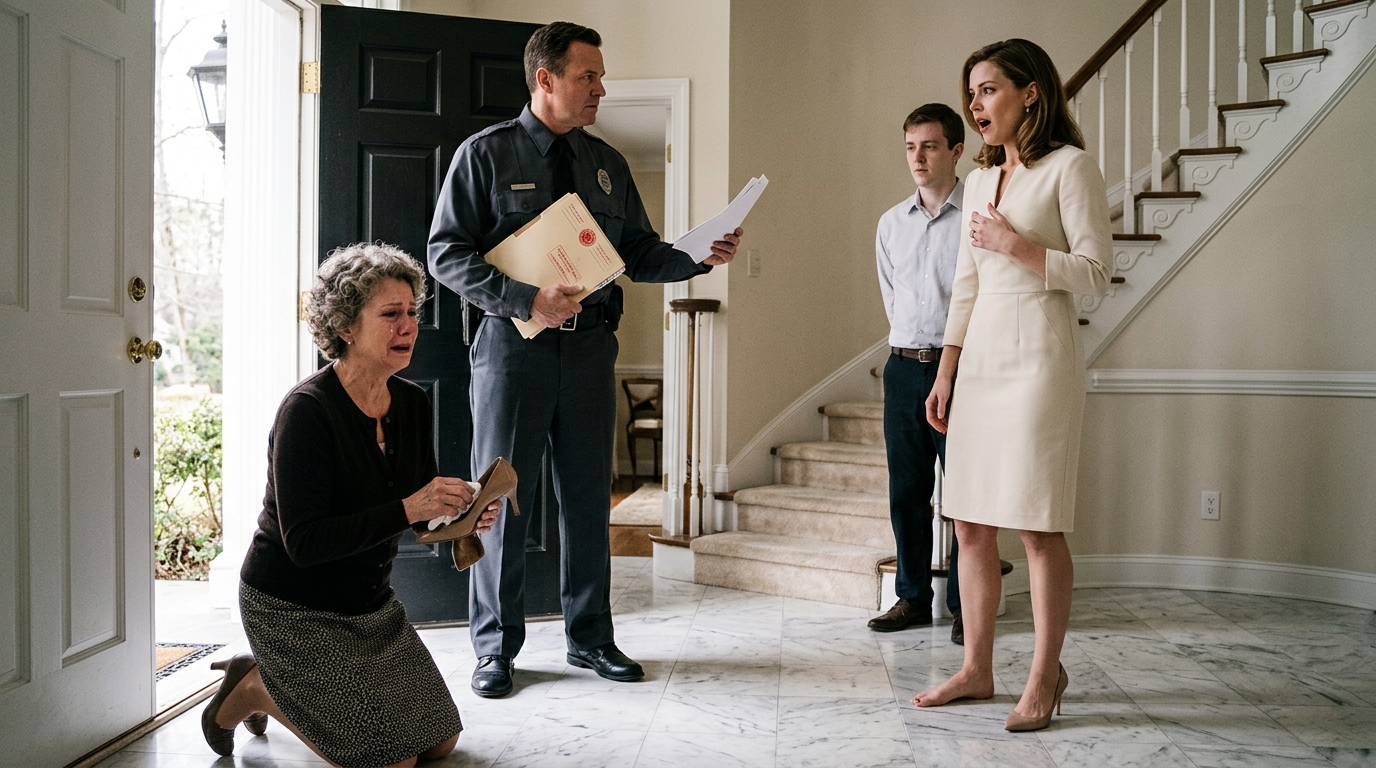
She was seventy-eight years old and on her knees in the center hall of Ashcombe Manor, wiping my fiancée’s heel with the edge of her own sleeve because her hands were shaking too badly to hold the cloth Vanessa had thrown at her.
The marble beneath her reflected everything.
The chandelier light.
The portraits on the walls.
The bare foot Vanessa kept extended toward her like an insult.
And me, standing near the staircase, doing nothing.
That is the truth I have to start with.
My name is Daniel Ashcombe.
I was forty-two that afternoon, and I let the woman I intended to marry make my mother small in the house where she had once made me feel safe.
Vanessa Cross understood humiliation the way musicians understand timing.
She never rushed it.
She knew exactly how long to let silence stretch before slicing through it again.
“Careful,” she snapped. “That shoe costs more than everything you own.”
My mother flinched as if the sentence had struck harder than the towel.
Her name is Helena Ashcombe.
She had been beautiful once in the old way—stillness, posture, dark hair always pinned, a kind of softness that never weakened into fragility. Even now, with age thinning her and grief carving lines around her mouth, there was something regal in her. Which, I think, was exactly what Vanessa hated.
Vanessa crossed her arms and tilted her head.
“Louder,” she said. “I want to hear you ask permission to stay in my house.”
My mother’s breath broke into sobs.
“I lived here… before you even knew his name…”
Vanessa laughed.
“Not anymore.”
She leaned down then, lowering her voice into something quieter and crueler.
“Once I marry your son, everything here becomes mine. The furniture. The land. The keys. Even the room you sleep in.”
My mother looked up at me through tears.
“Say something,” she whispered.
I didn’t.
That silence is the part I deserve least forgiveness for.
People think cowardice feels dramatic from the inside. It doesn’t. It feels practical. It sounds like exhaustion. It dresses itself up in phrases like this isn’t the moment and I’ll fix it later and if I interrupt now, things will get worse.
But it is still cowardice.
By then Vanessa had spent eleven months rewiring my judgment with frightening patience. My finances were in pieces after a failed acquisition and two quiet loans I had hidden from almost everyone. She knew the numbers. She knew the panic. She knew how easy it is to confuse certainty with love when you are drowning. She kept telling me my mother was manipulative, slipping, sentimental, obstructive. She said the house needed order. She said I needed help. She said old women used tears the way clever men use contracts.
So when my mother cried, I saw complication first.
That is what shames me most.
Not that I didn’t care.
That I let someone teach me the wrong language for what I was seeing.
Vanessa smiled wider when I stayed silent.
“See?” she said to my mother. “Even he knows where this is going.”
Then the front door opened.
Not dramatically.
No wind.
No thunder.
Just the clean mechanical sound of old iron shifting and a man stepping over the threshold with a leather folder stamped in red seals.
He was tall, in a dark overcoat, silver-haired, formal in the way government men become after years of carrying other people’s property disputes into rooms that thought themselves above paperwork. He stopped the moment he saw the scene.
My mother on her knees.
The shoe in her hand.
Vanessa standing over her.
Me by the staircase.
The room froze.
The man looked at Vanessa.
Then at my mother.
Then at the papers in his hand.
“Well,” he said slowly, “this is awkward.”
Vanessa straightened.
“What are you doing here?”
He stepped forward and raised the folder.
“The deed transfer finalized this morning.”
I frowned.
“What deed transfer?”
He turned toward my mother.
“This property now belongs entirely to her.”
My head snapped toward Helena.
Vanessa’s smile vanished.
“What?”
The officer’s eyes hardened.
“Yes,” he said. “And there’s one more detail you’re all going to want to hear.”
The Signature I Didn’t Recognize Until It Was Mine
His name was Richard Kessler.
Chief registrar for the county land office.
I knew him by sight, vaguely. I’d seen him once at a foundation dinner with my father years ago, though at the time he seemed like the sort of man people only remembered when they were already in trouble.
Now he stood in our hall and withdrew the top page from the folder with deliberate calm.
The paper bore the crest of the county registry.
A property seal.
And at the bottom—
my signature.
The shock was physical.
Not confusion.
Recognition arriving all at once.
Three months earlier Vanessa had brought me a set of papers late at night while I sat in my study with a bottle of bourbon and a spreadsheet full of numbers that no longer obeyed reality. She said my father had set up an “interim protective structure” before his trip abroad. Asset shielding. Trustee witness confirmation. Temporary administrative housekeeping.
I signed because I was tired.
Because I trusted her more than I trusted my own concentration.
Because the pages were thick and official-looking and the words blurred after midnight.
Because men lose fortunes long before they lose houses, and once that happens, they sign almost anything that sounds like control.
Kessler turned the page so all of us could see.
“Irrevocable transfer of title,” he read, “Ashcombe Manor, the west gardens, the orchard tract, and all protected residential rights to Helena Margaret Ashcombe.”
My mother stared at him as though he were speaking another language.
Vanessa found her voice first.
“This has to be a mistake.”
Kessler did not look at her.
“It isn’t.”
He handed me the certified copy.
My own signature sat there cleanly beneath a witness line I remembered far too late. Not because I had approved the transfer knowingly—but because I had authorized it without reading the trigger clauses attached.
I looked at my mother.
She looked back at me.
That nearly broke me.
No anger.
No accusation.
Just the terrible realization in both our faces that I had once held the power to protect her and didn’t know I was holding it.
Vanessa recovered fast.
She always did.
“Even if the title changed,” she said sharply, “that doesn’t mean anything about occupancy. Daniel and I are to be married. This is a family matter.”
Kessler withdrew a second sheet.
“Oh, it means quite a bit more than occupancy.”
He read from the page.
“Supplemental protective covenant: if Helena Margaret Ashcombe is humiliated, coerced, removed from ordinary standing, pressured to surrender room, keys, or residency, or forced into service within the house by any heir, guest, intended spouse, or associate acting in anticipation of gain, then said associate is immediately barred from marital claim, residence, future occupancy, or beneficial interest attached to the property.”
Vanessa went pale.
I went colder.
Because I understood then that this was no simple transfer.
It was a trap.
No.
That is too kind to me.
It was a test.
One my father had designed months earlier, long before his stroke, long before the rumors about my debt began circling through the family office, long before Vanessa started speaking about “transition plans” for my mother as if widowhood were an administrative inconvenience.
Kessler lifted his eyes from the page.
“In plain terms,” he said, “Miss Cross cannot live here, cannot acquire rights through marriage to you, and cannot remain on the premises if Mrs. Ashcombe demands her removal.”
The silence that followed felt structural.
As if the house itself had shifted on its foundations.
Vanessa laughed once.
It sounded wrong.
Thin.
Too late.
“Daniel, say something.”
But before I could, Kessler slid one final document from the folder and placed it on the console table beside the flower bowl.
“This,” he said, “is the notation you signed without reading. The one your father insisted be filed only after the title passed.”
I looked down.
The heading read:
Dignity Preservation Addendum.
And at the bottom of that page, beneath legal language that now felt like accusation, was another line I had countersigned without ever understanding what it would cost to ignore.
If the son remains silent during verified humiliation, his discretionary trust authority is suspended pending review.
My knees nearly gave.
Because the deed transfer had not been written only for my mother.
It had been written against me.
The Plan Hidden in Her Handbag
Vanessa did what clever people do when truth enters the room faster than charm can reach it.
She changed targets.
“This is manipulation,” she snapped. “A senile old man and a grieving widow and now some bureaucrat with a seal—”
“Miss Cross,” Kessler said, “your objection would land more cleanly if your handbag did not contain draft release documents.”
The hall went dead still.
Vanessa blinked once.
That was all.
But it was enough.
My stomach turned.
Kessler held out his hand. “Would you like to produce them yourself?”
“No.”
“Then I suggest Mr. Ashcombe does.”
I moved before I had to think.
Her cream leather bag sat on the entry bench where she’d thrown it earlier. I brought it back to the table with hands that no longer felt like mine.
Vanessa took one step toward me. “Don’t.”
I ignored her.
I upended the bag.
Everything spilled across polished wood.
Lipstick.
Keys.
Phone.
A silver compact.
An unlabeled pill case.
And a slim folder clipped in gold.
My mother made a sound when she saw the first page.
Voluntary Surrender of Residential Privilege.
Name line: Helena Margaret Ashcombe.
The second page was worse.
Preliminary Capacity Concern Memorandum.
Prepared for private physician review.
The third page made the blood leave my face entirely.
Prestige Assisted Living Intake Packet.
Room preference options.
Medical transport notes.
Expedited family signature field.
Vanessa’s voice changed then. Lost its polish. Became almost feral.
“She can’t manage this house.”
My mother laughed once through tears.
A soft, broken sound.
“I chose these floors,” she said. “I rebuilt the north wing after the fire. I paid the staff when your father’s investors pulled out in ’89. And you thought I couldn’t manage a hallway.”
Kessler picked up the silver pill case.
“What is this?”
Vanessa went still.
He opened it.
Inside were pale tablets in two unlabeled compartments.
My mother closed her eyes.
“The tea,” she whispered.
I turned toward her.
“For weeks I thought I was losing time,” she said. “After supper. In the afternoons. I’d sit down and wake two hours later. My hands felt heavy. Words slid away from me.”
Vanessa tried once more.
“They’re sleep aids. She asked for help.”
“No,” my mother said, and for the first time that day her voice held something harder than grief. “I asked for rest. Not erasure.”
Kessler set the pills beside the intake packet and reached into his folder again.
“There’s more.”
He placed a printout on the table.
Email chain.
Broker correspondence.
Forwarded from Vanessa’s account.
At the top, in a subject line stamped three hours earlier:
Window of Compliance.
Under it, her words.
Mother is finally breaking. If the crying continues, I believe we can secure a voluntary release tonight before the son has the spine to reconsider. Father is incapacitated and the old title structure collapses once marriage is formalized.
I read that line twice.
Then a third time.
Father is incapacitated.
She thought my father was too ill to interfere.
That explained the urgency.
The theatrics.
The shoe.
The demand to ask permission to stay.
This had never been a burst of cruelty.
It had been staging.
My father’s protective clause had not merely anticipated greed.
It had anticipated choreography.
And then Kessler said the sentence that told me this was even bigger than the house itself.
“Your father attached a second affidavit,” he said. “One concerning a prior pattern in Geneva.”
The Woman My Father Investigated Before He Collapsed
He had known.
Not everything.
But enough.
That knowledge hit me harder than the deed.
Because if my father had suspected Vanessa before his stroke, then he had seen through what I called love while I was still defending it.
Kessler read from the affidavit.
“Statement from Alain Rousseau, Geneva, regarding attempted coercive removal of widow from residence by prospective daughter-in-law through staged public incompetence, emotional pressure, and private sedation.”
Vanessa’s face lost all remaining color.
I looked at her.
She saw that I finally understood.
And for the first time since I had known her, she dropped the performance completely.
“You think old women don’t manipulate?” she hissed. “You think houses like this survive on sentiment? His mother is dead weight. She’s a relic in silk. This place is bleeding value while you all light candles to memory and call it legacy.”
There it was.
Not strategy.
Not order.
Contempt.
For age.
For grief.
For anything that could not be converted into leverage.
“You made her scrub a shoe,” I said.
It sounds absurd now, how small the sentence was compared to everything else on the table.
But some acts carry the whole architecture inside them.
Vanessa turned to me as if she still expected something salvageable.
“It was a scene. She needed to understand what was coming.”
My mother looked away.
That hurt more than her tears had.
Because it meant she had believed, at least for a few minutes, that my silence was agreement.
Kessler closed the folder.
“Mrs. Ashcombe has full authority to remove Miss Cross from the premises immediately. Additionally, due to the trust suspension, Mr. Ashcombe cannot override that decision.”
Vanessa stared at me.
Then at my mother.
Then at the front door.
For one wild second I thought she might run.
Instead she said, very quietly, “Daniel. Say this is ridiculous.”
My mouth opened.
Nothing came.
Then, finally, I looked at my mother.
Really looked.
Her knees were red where marble had pressed through fabric.
Her hair had come loose.
Her sleeve was dirty from the shoe.
And beneath all of it was the thing I had refused to name for months because naming it would have required action.
She was afraid of us in her own house.
That realization changed the air in my lungs.
“Leave,” I said.
Vanessa blinked.
“Daniel—”
“Leave.”
It was not loud.
It did not need to be.
The force of it came not from anger but from how late it had arrived.
Her eyes filled instantly—not with grief, not even rage, but with the stunned contempt of someone discovering that the weak man she had been arranging had finally chosen the wrong moment to grow a spine.
“You’ll regret this.”
“I already do.”
The front bell rang then.
Sharp.
Formal.
Final.
Kessler did not seem surprised.
“I asked local police to stand by outside,” he said. “Given the medication and the attempted coercion, I thought it prudent.”
Vanessa looked at the door.
Then at the pills.
The forms.
The email chain.
The deed.
She understood, at last, that there was no version of this afternoon left to manage.
And that was when my mother, still trembling, said the thing that ended her.
“Take the shoe,” Helena whispered, “and get out of my house.”
The House That Finally Chose Her
The police entered quietly.
No spectacle.
No raised voices.
Just two officers, a woman and a man, polite enough to make consequence feel even colder. Kessler handed over the pill case first. Then the printed emails. Then the unsigned surrender forms. Then the intake packet.
Vanessa tried tears once.
Then indignation.
Then the brittle, educated outrage of wealthy women who believe rules are decorative until applied to them personally.
None of it worked.
The female officer asked if she wished to provide an explanation for the medication.
Vanessa said nothing.
She asked about the coercive paperwork.
Vanessa said, “This family has misunderstood my intentions.”
The officer actually looked at the pages and replied, “Intent seems fairly clear.”
That was the moment the room shifted from family drama into record.
Statement.
Evidence.
Custody of documents.
Witnesses present.
No amount of elegance survives that translation untouched.
While the police spoke to her, I crossed the hall and crouched in front of my mother.
I had no speech prepared.
No sentence dramatic enough to earn forgiveness.
I reached for the dirty cloth still lying beside her chair and picked it up.
Then, without really thinking, I knelt on the marble where she had been forced down.
She stared at me.
The officers paused.
Kessler paused.
Even Vanessa went still.
“I’m sorry,” I said.
It was useless.
True.
Late.
All at once.
My mother’s eyes filled again, but this time the tears changed shape.
Not humiliation.
Grief.
Because apology, when it arrives after betrayal, doesn’t erase what happened. It simply forces both people to look at the wound without the lie covering it.
“You were my son before you were her witness,” she said softly.
I bowed my head.
“I know.”
“No,” she replied. “Now you know.”
That landed exactly where it needed to.
The officers led Vanessa toward the door.
She stopped only once, turning back toward me with hatred so cold it felt almost clarifying.
“You think this house saved you?”
I looked at her.
“No,” I said. “She did.”
The front door shut behind them.
The silence after was not empty.
It was exhausted.
Kessler gathered the remaining papers and set one sealed envelope on the entry table.
“Your father asked that this be opened only if the clause was triggered.”
My pulse jumped.
I broke the seal.
Inside was one page in my father’s hand.
Daniel,
If you are reading this, then I was right about two things: the woman was wrong for this house, and my son was weaker than he believed.
The property is your mother’s because dignity should never depend on inheritance.
Your authority is suspended because silence is a form of vote.
Restore what you permitted, and perhaps the board will one day reconsider you.
Do not waste time defending yourself to the dead.
Stand beside the living and make yourself useful.
—Father
I read it once.
Then handed it to my mother.
She did not smile.
Did not cry again.
She simply folded the letter carefully and placed it atop the deed.
Kessler inclined his head to her. “Mrs. Ashcombe, as of this morning, you are sole title holder. If you wish, the locks can be changed tonight.”
“Yes,” she said.
Her voice was quiet.
But it belonged to the house again.
After Kessler left, after the staff retreated to their quarters in shaken silence, after the evening fell across the windows and turned the hall mirrors dark, I stayed there with her beneath the portraits.
The towel was still on the floor.
The shoe still lay near the staircase where Vanessa dropped it.
The marble still reflected us both.
I picked up the shoe first.
Then the towel.
Then the surrender packet.
And one by one, under my mother’s gaze, I carried each of them to the fire in my father’s study.
I watched the unsigned forms blacken.
Curl.
Disappear.
When I came back, she was still standing in the hall.
A small woman in a dark dress, seventy-eight years old, tired beyond measure, and somehow taller now than anyone else I had seen all day.
“Go rest,” I said.
She looked at me for a long time.
Then, to my surprise, touched my cheek with the back of her fingers the way she used to when I was a child feverish with something I could not name.
“The room I sleep in,” she said softly, “was never hers to threaten.”
I swallowed hard.
“No.”
“And neither were you.”
That nearly finished me.
Because that was the final cruelty Vanessa had managed—to make me feel transferable. Like a key, a title, a room. Something a stronger will could simply pocket and use.
But my mother, even after the shoe, the floor, the tears, and my silence, still spoke as though I might become more than the worst thing I had done.
That is mercy.
And that night, in the house whose deed had quietly shifted beneath all our feet before the door ever opened, I finally understood what my father had built into those documents.
He had not just protected a property.
He had drawn a line between love and possession, between grief and weakness, between marriage and conquest, and then waited to see who crossed it when they thought no one was watching.
Vanessa crossed it.
I stood still and failed it.
My mother survived it.
And because she did, the house remained what it had always truly been:
not marble,
not land,
not keys,
not furniture,
but the one place where the woman they tried to reduce to a servant still had the final word.